
Best starting point: Vue Mesh Extended Height Ergonomic Stool by Safco; 3395BL. Best saddle option with back support: Ergonomic Comfortable Saddle Style Chair With Footrest & Backrest. Best for adjustable twin-seat seating: USA Patented Twin Adjustable Saddle Stool with FootRing by Kanewell. Best clinical-task alternative: Ergonomic Surgeon Chair with FootRest for Precision Surgical and Dental Work. This 2026 drafting chair guide explains which designs to shortlist and how to confirm they fit your standing-height workspace.
- The Safco Vue extended-height stool is the first drafting chair to investigate for a higher work surface.
- Choose the Ergonomic Comfortable Saddle Style Chair when your shortlist requires a saddle seat, backrest, and adjustable footrest.
- The Kanewell FootRing model combines a twin saddle seat with seat-height and posture-angle adjustment.
- Sithealthier drafting chair options require a workspace fit check; a footrest alone does not establish suitable seat height.
Why this matters
A standing-height desk creates two separate seating requirements: you need to reach the work surface comfortably, and you need somewhere to support your feet. A chair that solves only one requirement is not a complete fit.
For dental and medical professionals, the desk is only part of the decision. Patient access, instrument placement, pedals, and the route into the seat also matter. For home-office buyers, keyboard position and clearance beneath the desktop deserve the same attention.
Sithealthier offers ergonomic office, medical, and dental seating. For your 2026 purchase, choose a drafting chair by its usable height and task fit—not by the presence of a footring or an ergonomic label.
What makes the best drafting chair?
Use these criteria before comparing individual models. They separate a useful shortlist from a chair that simply looks suitable beside a tall desk.
- Seat-height fit: Confirm the lowest and highest usable seat positions against your actual work surface. Do not substitute overall chair height for seat height.
- Foot support: Check where your feet rest when the seat is at working height. Consider footrest position alongside any pedals you use.
- Seat shape: Decide whether you want a conventional seat or a saddle design. Compare the actual seating position rather than assuming they feel interchangeable.
- Back and arm clearance: Check whether supports let you approach the desk or patient closely enough without blocking movement.
- Adjustment access: Identify the controls you need during work and whether you can reach them from the intended seated position.
- Workspace compatibility: Confirm base clearance, floor suitability, cleaning instructions, and the exact configuration before ordering.
Best drafting chair options at a glance
The order below follows the selection process: start with a product explicitly described for higher tables, then consider saddle and clinical-task alternatives. These are use-case shortlists, not claims that every model fits every standing-height desk.
| Item | Best for | Stated feature | Key limitation to resolve |
|---|---|---|---|
| Vue Mesh Extended Height Ergonomic Stool by Safco; 3395BL | Higher-table work | Extended-height stool described for higher tables | Confirm the actual seat-height range and foot-support configuration |
| Ergonomic Comfortable Saddle Style Chair With Footrest & Backrest | Saddle seating with back and foot support | Adjustable footrest and backrest; hydraulic height adjustment | Confirm saddle fit and clearance beneath your desk |
| USA Patented Twin Adjustable Saddle Stool with FootRing by Kanewell | Twin-seat posture adjustment | Pneumatic seat-height control and posture-angle adjustment | Confirm seat dimensions and the footring's usable position |
| Ergonomic Surgeon Chair with FootRest for Precision Surgical and Dental Work | A clinical-task shortlist | Surgeon-chair design with footrest | Clinical positioning does not establish standing-desk compatibility |
1. Safco Vue: best drafting chair shortlist for higher tables
The Vue Mesh Extended Height Ergonomic Stool by Safco; 3395BL is the clearest starting point for this query because its product description explicitly identifies higher-table work. That makes it more directly relevant than choosing an ordinary office chair and assuming it rises far enough.
Best for: Buyers whose main requirement is seating at a higher work surface, including clinical documentation stations and home workspaces.
Safco Vue pros:
- Explicitly described as an extended-height ergonomic stool.
- Product description identifies higher tables as its intended setting.
- Provides a straightforward first comparison against saddle alternatives.
Safco Vue cons:
- The extended-height designation does not establish compatibility with your particular desk.
- You still need to confirm foot support, seat dimensions, and adjustment details before choosing a configuration.
For a 2026 shortlist, start by matching the seat-height range to your desk rather than treating the model name as a complete specification. Then check whether you can approach the keyboard without reaching around the desk edge or any chair supports.
The Safco Vue is the default product to investigate here, not an automatic purchase. Verdict: Hold until seat height, foot support, and desk clearance are confirmed.
2. Saddle chair with backrest: best for combined support features
The Ergonomic Comfortable Saddle Style Chair With Footrest & Backrest combines a saddle seat with an adjustable footrest and backrest. Its description also identifies hydraulic height adjustment and 360-degree swivel casters.
Best for: Buyers who specifically want saddle seating with both back and foot support, rather than a conventional drafting-chair seat.
Ergonomic Comfortable Saddle Style Chair pros:
- Combines a saddle seat, backrest, and footrest in one model.
- Includes an adjustable footrest rather than relying only on floor contact.
- Hydraulic height adjustment supports setup changes within the model's specified range.
Ergonomic Comfortable Saddle Style Chair cons:
- A saddle seat needs a fit check; the category name does not establish comfort for an individual user.
- Backrest and footrest positions need checking against desk clearance and access routes.
Compare this model at the height you will actually use. A comfortable position away from the desk does not establish that the same setup works under the desktop, especially where drawers or support rails occupy leg space.
For clinical work, include pedal access in that check. Verdict: Hold until the saddle position and full working-height setup fit your task.
3. Kanewell FootRing: best for twin-seat posture adjustment
The USA Patented Twin Adjustable Saddle Stool with FootRing by Kanewell combines a twin saddle seat with pneumatic seat-height control and posture-angle adjustment. It belongs on your shortlist when seat configuration matters alongside elevated foot support.
Best for: Buyers comparing a twin saddle seat with angle adjustment against a conventional drafting stool.
Kanewell FootRing pros:
- Twin saddle design provides a distinct seat option to compare.
- Pneumatic seat-height control allows height adjustment within the specified range.
- Posture-angle adjustment adds a separate setup variable.
- Includes a footring in the named configuration.
Kanewell FootRing cons:
- A twin seat is not automatically a better fit than a single-piece saddle or conventional seat.
- Height, angle, and foot support must work together; checking each feature separately is insufficient.
When comparing this model in 2026, change one adjustment at a time. Establish seat height first, evaluate the seat angle next, and then check foot support without losing access to the work surface.
Do not assume that specifications from another Kanewell model apply to the FootRing version. Match the exact product and configuration to your measurements. Verdict: Hold until the twin-seat fit and footring position are confirmed.
4. Surgeon Chair: best for a clinical-task comparison
The Ergonomic Surgeon Chair with FootRest for Precision Surgical and Dental Work is a relevant alternative when your seating decision starts with clinical work rather than desk work. Its stated identity is a surgeon chair with a footrest, not a general-purpose extended-height drafting stool.
Best for: Dental and medical professionals comparing task-specific clinical seating with an elevated desk chair.
Ergonomic Surgeon Chair pros:
- Named specifically for surgical and dental work.
- Includes a footrest in the product configuration.
- Keeps the buying decision focused on the clinical task rather than office-chair appearance.
Ergonomic Surgeon Chair cons:
- The surgeon-chair label does not establish compatibility with a standing-height desk.
- A footrest does not confirm that pedals, patient access, or instrument reach will work in your room.
If you split time between procedures and documentation, evaluate both positions. A chair suited to one station still needs a separate check at the other; moving the same chair between them does not make their requirements identical.
Do not interpret the product category as evidence of pain relief or a guaranteed health outcome. Verdict: Hold until the clinical setup and any desk use both pass a fit check.
Product details to compare next
These product cards identify the extended-height starting point and the saddle option with back and foot support. Compare the exact configuration against your measurements before making a purchase decision.


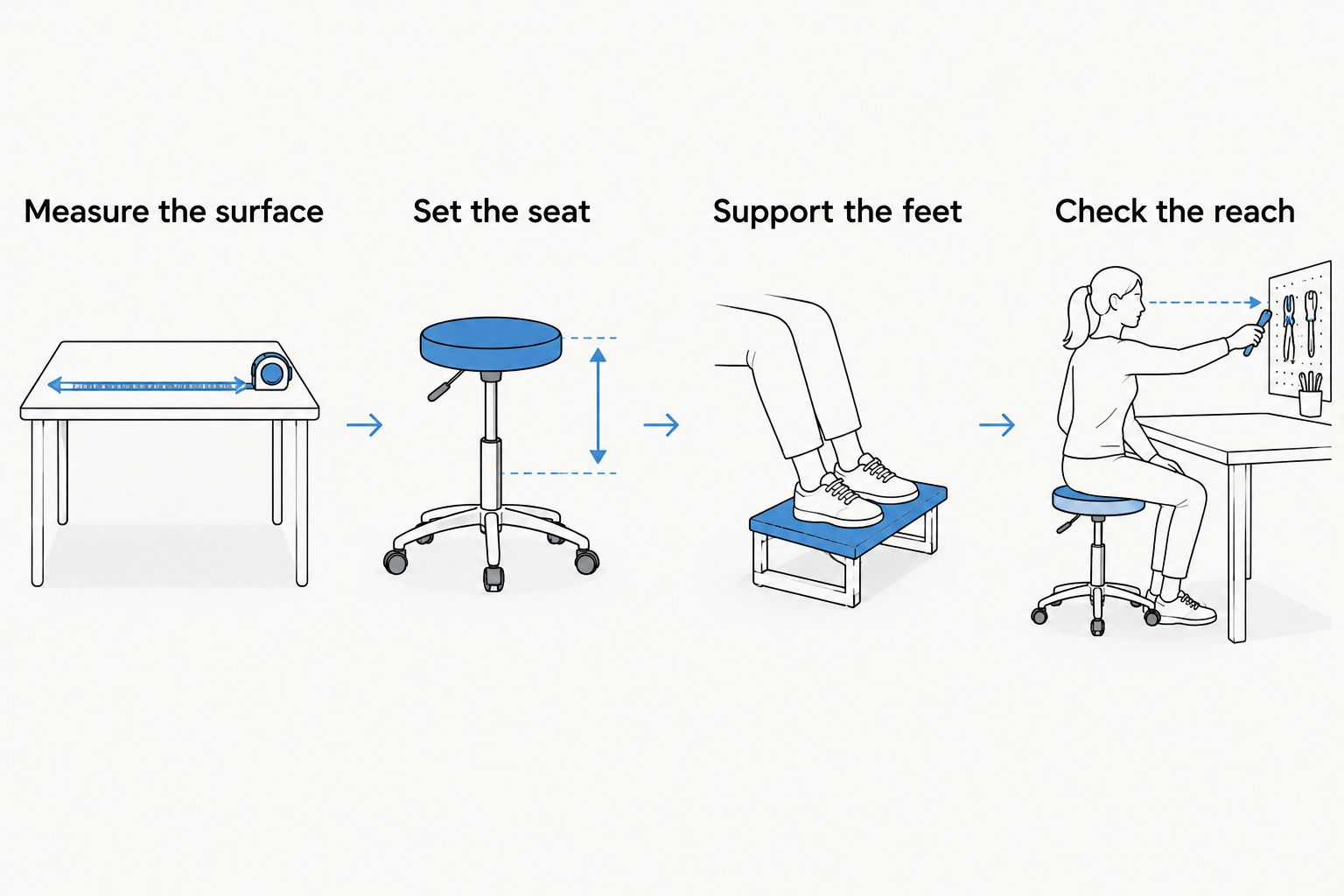
How to check a drafting chair against your workspace
A useful 2026 comparison starts with your room, not a generic recommended desk height. Record measurements in inches or centimeters and use the same unit throughout your comparison.
Measure the surface
Measure the work-surface height and the clear space underneath it. Include drawers, rails, and equipment mounts; the visible desktop is not the whole clearance envelope.
For an adjustable desk, record the position you intend to use while seated. You do not need to keep the desk at its standing position simply because the chair can rise higher.
Set the seat
Compare the chair's specified seat-height range with your working position. Check whether you can use the keyboard or instruments without lifting your shoulders or stretching forward to reach them.
Treat height as a usable range, not a target to maximize. The highest setting is not inherently the most suitable one.
Support the feet
Check where your feet rest once the seat is set correctly. A footring needs to suit that position; its presence in the product name is only the beginning of the assessment.
In a clinic, repeat the check while using any required pedal. Foot support and pedal access need to coexist without forcing an awkward working position.
Check the reach
Move into the actual working position and assess the route to your tools. Check whether the seat, backrest, supports, or base prevent you from getting close enough.
Repeat the check when entering and leaving the chair. A setup that works only after squeezing around equipment is not a useful everyday arrangement.
What to confirm before ordering
Send your measurements and task requirements with any fit inquiry. Ask for the exact seat-height range, seat dimensions, footrest adjustment details, and base dimensions for the configuration you are considering.
For a clinical purchase, also confirm the manufacturer's cleaning instructions against your workplace requirements. Do not infer cleaning compatibility from upholstery appearance or from a medical product name.
Check the complete chair's stated capacity rather than borrowing a rating from a replacement base or another model. Likewise, do not assume an optional cylinder, caster, or arm support fits without explicit compatibility information.
Keep the decision specific: name the chair, the configuration, the work-surface height, and the task. That gives you a useful answer instead of a general assurance that a chair is ergonomic.
How these options were ranked
This 2026 ranking prioritizes explicit higher-table suitability, then separates saddle adjustment and clinical-task requirements into distinct use cases. The product descriptions establish those categories; the workspace checks determine whether a shortlisted chair belongs in your room.
Sithealthier drafting chair comparisons are most useful when they distinguish a stated feature from a fit conclusion. No hands-on testing, clinical outcome, or universal compatibility claim forms part of this ranking.
Which drafting chair should you choose?
Start with the Safco Vue if your main requirement is seating at a higher table. Compare the Ergonomic Comfortable Saddle Style Chair if you want a saddle seat with adjustable back and foot support instead.
Choose the Kanewell FootRing model for closer investigation when twin-seat design and posture-angle adjustment are priorities. Put the Ergonomic Surgeon Chair on the clinical shortlist when procedure positioning matters more than general desk seating.
The deciding factor is the complete working position. If a shortlisted chair cannot meet your seat-height, foot-support, and access requirements together, skip it for that station.
FAQ
What's the best drafting chair for a standing-height desk?
The Vue Mesh Extended Height Ergonomic Stool by Safco; 3395BL is the clearest starting point in this shortlist because its description explicitly identifies higher-table work. Confirm its seat-height range and foot-support configuration against your desk before ordering.
Can I use a saddle stool instead of a drafting chair?
Yes, if the saddle stool's specified height range and support configuration fit your workspace. A saddle seat or footring alone does not establish suitability for a standing-height desk.
Does every drafting chair need a footring?
You need suitable foot support when your working seat position prevents comfortable floor contact. A footring is one option, but its usable position matters more than its presence in the product name.
Is a surgeon chair suitable for a standing desk?
A surgeon chair is suitable only when its verified dimensions and adjustments match the desk setup. A clinical product name does not establish elevated-desk compatibility.
Should I choose a backrest or a backless saddle stool?
Choose according to your task, fit, and clearance requirements rather than assuming either design is universally better. Evaluate the chair in the working position where you will use it.
What measurements should I take before buying a drafting chair?
Record work-surface height, underside clearance, and the space available around the station. Compare those measurements with the exact chair's seat-height range, seat dimensions, base dimensions, and foot-support details.
Will an ergonomic drafting chair cure my back pain?
An ergonomic drafting chair is not a promised cure for back pain or any medical condition. Select seating for task fit and adjustment, and seek individualized medical advice for persistent symptoms.
One last thing
Check the underside of the desk before choosing a taller chair. Raising the seat also brings your legs closer to drawers, rails, and equipment mounts; a desktop-height match can still fail the clearance check.
For your 2026 purchase, bring those measurements to Sithealthier alongside the name of your shortlisted model. Resolve the fit question before committing to a chair category.
Leave a comment