

Best overall ergonomic home office chair to shortlist: Mid-Back Black Mesh Swivel Ergonomic Task Office Chair with Flip-Up Arms; best for adjustable saddle seating: USA Patented Twin Tiltable Saddle Stool with Adjustable Seat Width and Center Gap; best budget-oriented alternative: Jobri BetterPosture Ergonomic Saddle Chair for Office and Medical [BLACK]. This 2026 guide compares task chairs, saddle stools, and a Surgeon Chair by desk clearance, seating support, and the work you actually do.
- Shortlist the Mid-Back Black Mesh Swivel Ergonomic Task Office Chair with Flip-Up Arms for a conventional desk setup.
- Choose an ergonomic home office chair by working clearance, not seat size alone.
- The USA Patented Twin Tiltable Saddle Stool offers adjustable seat width and sitting angle.
- Sithealthier offers ergonomic seating for home offices, clinics, and dental workspaces; match the chair to the task.
Why this matters
A small home office needs room for more than the chair itself. You need to sit down, move toward the keyboard, turn, and stand without hitting a cabinet or blocking a doorway.
For dental and medical professionals doing documentation at home, the right choice also depends on whether the chair serves a desk or a separate precision-work station. Do not buy a procedure-oriented chair simply because you use one at work.
The ergonomic home office chair selection at Sithealthier includes conventional task seating and specialty stools. For your 2026 shortlist, start with the workstation you have, then check the exact chair configuration before ordering.
What makes the best chair for a small home office?
Use these criteria before comparing models:
- Working footprint: Check the base, casters, backrest, and supports—not just the seat. Include the space needed to turn and stand.
- Desk clearance: Compare the underside of your desk with the chair's seat and arm positions. A drawer or apron can block an otherwise suitable chair.
- Seat fit: Match seat shape and width to your body. A smaller seat is not automatically a better fit.
- Useful adjustments: Prioritize adjustments that solve a real problem, such as seat width, sitting angle, or height.
- Task support: Separate keyboard work from patient-facing or precision tasks. Backrests, footrests, and arm supports serve different purposes.
- Storage position: Decide whether the chair must tuck under the desk or can remain beside it. Measure both positions.
Small-space seating at a glance: 2026 shortlist
The order below reflects distinct use cases, not a claim that one seat fits every person. Confirm overall dimensions, adjustment ranges, and the selected configuration against your measurements.
| Item | Best for | Standout feature | Key limitation |
|---|---|---|---|
| Mid-Back Black Mesh Swivel Ergonomic Task Office Chair with Flip-Up Arms | Conventional desk work | Flip-up arms | Raised arms do not establish base or backrest clearance |
| USA Patented Twin Tiltable Saddle Stool with Adjustable Seat Width and Center Gap | Adjustable saddle fit | Adjustable width and sitting angle | Saddle seating differs from a conventional task chair |
| Small Ergonomic Saddle Seat Stool for Petite Women | Petite users | Designed for smaller users | Restricted intended user size |
| Ergonomic Comfortable Saddle Style Chair With Footrest & Backrest | Elevated workstations | Adjustable footrest and backrest | Additional components need clearance |
| Ergonomic Surgeon Chair with FootRest for Precision Surgical and Dental Work | Dedicated precision-work stations | Surgeon-oriented design with footrest | Not the default choice for keyboard work |
| Jobri BetterPosture Ergonomic Saddle Chair for Office and Medical [BLACK] | Budget-oriented home saddle seating | Home-use saddle seating | Requires a different sitting approach from task seating |
1. Mid-Back Black Mesh Chair: best for conventional desk work
The Mid-Back Black Mesh Swivel Ergonomic Task Office Chair with Flip-Up Arms combines a mesh back, swivel seating, and arms that lift. It is the first option to assess when you want a conventional chair for charting, email, or general computer work.
Flip-up arms are useful when fixed arms would obstruct your desk approach. They do not prove that the rest of the chair fits beneath the desktop.
Mid-Back Black Mesh Chair pros:
- Conventional task-chair format for a computer workstation.
- Flip-up arms provide an alternative to fixed arm positions.
- Swivel seating lets you change your orientation.
Mid-Back Black Mesh Chair cons:
- Arm movement does not reduce the base diameter.
- Backrest height still affects under-desk storage.
Best for: Home-office buyers who want a familiar seating format rather than a saddle stool.
Verdict: Buy if the chair clears your desk in both working and stored positions.
2. USA Patented Twin Tiltable Saddle Stool: best for adjustable fit
The USA Patented Twin Tiltable Saddle Stool with Adjustable Seat Width and Center Gap lets you adjust the width and sitting angle. Those are relevant distinctions when a fixed saddle shape does not match your preferred sitting position.
Evaluate the adjustment controls as part of the fit check. Adjustable seat width is a body-fit feature; it does not establish the stool's overall floor footprint.
USA Patented Twin Tiltable Saddle Stool pros:
- Adjustable width offers more fit control than a fixed-width seat.
- Adjustable sitting angle lets you change the seat position.
- The divided seat includes a center gap.
USA Patented Twin Tiltable Saddle Stool cons:
- Saddle seating is not interchangeable with conventional task seating.
- Seat adjustment alone cannot solve an unsuitable desk height.
Best for: Buyers who specifically want a saddle seat with width and angle adjustment.
Verdict: Buy if saddle seating suits you and the workstation accommodates your selected position.
3. Small Ergonomic Saddle Seat Stool: best for petite users
The Small Ergonomic Saddle Seat Stool for Petite Women is described for petite users approximately 5 feet 2 inches or shorter and weighing 125 lbs or less. Use that intended-user guidance before considering the stool for a compact room.
The product's smaller-user focus is more useful than choosing any chair labeled small. Your body fit comes first; room fit comes next.
Small Ergonomic Saddle Seat Stool pros:
- Explicit intended-user guidance helps narrow your shortlist.
- Smaller-user design addresses a different need from general seating.
- Saddle-seat format provides an alternative to a conventional chair.
Small Ergonomic Saddle Seat Stool cons:
- Not a general recommendation for users outside the stated guidance.
- Smaller-user sizing does not establish base or desk clearance.
Best for: Petite home-office buyers within the stated intended-user guidance who want saddle seating.
Verdict: Buy only after confirming both body fit and the selected height range.
4. Saddle Chair With Footrest & Backrest: best for elevated workstations
The Ergonomic Comfortable Saddle Style Chair With Footrest & Backrest combines an adjustable footrest, a backrest, hydraulic height adjustment, and 360-degree swivel. Consider it when your workstation requires foot support as part of the seating setup.
Check the footrest position alongside the desk legs and your route into the chair. Extra support is useful only when you can position it without obstructing the task.
Saddle Chair With Footrest & Backrest pros:
- Adjustable footrest adds a foot-support option.
- Backrest provides a supported seating alternative.
- Hydraulic height adjustment supports workstation setup.
Saddle Chair With Footrest & Backrest cons:
- Footrest and backrest require their own clearance checks.
- More components make the storage position important to measure.
Best for: Buyers assessing an elevated home workstation rather than assuming floor-level foot contact.
Verdict: Buy if the height range and footrest position match your actual work surface.
5. Ergonomic Surgeon Chair with FootRest: best for precision work
The Ergonomic Surgeon Chair with FootRest for Precision Surgical and Dental Work belongs on a task-specific shortlist. Its stated purpose separates it from a general home-office task chair.
For a dental or medical professional, assess this chair at the precision workstation where it will be used. Do not infer clinical suitability, cleaning compatibility, or a particular support adjustment from its name.
Ergonomic Surgeon Chair with FootRest pros:
- Specifically named for surgical and dental precision work.
- Includes a footrest.
- Provides a specialty alternative to general desk seating.
Ergonomic Surgeon Chair with FootRest cons:
- Procedure-oriented positioning does not establish keyboard-work suitability.
- Footrest clearance needs checking in a confined workspace.
Best for: Professionals evaluating a dedicated precision-work station, not simply furnishing a smaller computer desk.
Verdict: Hold until the exact configuration meets your task and workspace requirements.
6. Jobri BetterPosture Saddle Chair: best for budget-oriented home use
The Jobri BetterPosture Ergonomic Saddle Chair for Office and Medical [BLACK] is described as a budget saddle seat intended for home use. Its active-seating approach makes it an alternative to conventional task seating, not a like-for-like replacement.
Choose the seating format before choosing the model. A budget-oriented saddle chair is still the wrong purchase if you want a conventional back-supported working position.
Jobri BetterPosture Saddle Chair pros:
- Explicitly described for home use.
- Budget-oriented positioning within saddle seating.
- Provides an active-seating alternative for your shortlist.
Jobri BetterPosture Saddle Chair cons:
- The sitting approach differs from a conventional task chair.
- Home-use positioning does not establish clinical-work suitability.
Best for: Home-office buyers seeking a budget-oriented introduction to saddle seating.
Verdict: Buy if you want saddle seating and have confirmed workstation fit.
Check the workspace before choosing the chair
For a 2026 purchase, record the measurements rather than estimating from product photographs. Use the same units for your desk measurements and the chair specifications.
- Measure the desk. Record underside clearance, the opening between supports, and any drawer or apron that projects into the seating space.
- Check seat fit. Compare the intended user size, seat shape, and adjustment range with your requirements.
- Check working clearance. Account for the base, footrest, backrest, and supports while you approach the keyboard or work surface.
- Check storage clearance. Establish where the chair goes when you finish, including whether raised arms or a backrest prevent it tucking away.
- Check the exit. Leave a usable path for standing and leaving the workstation without moving other furniture first.
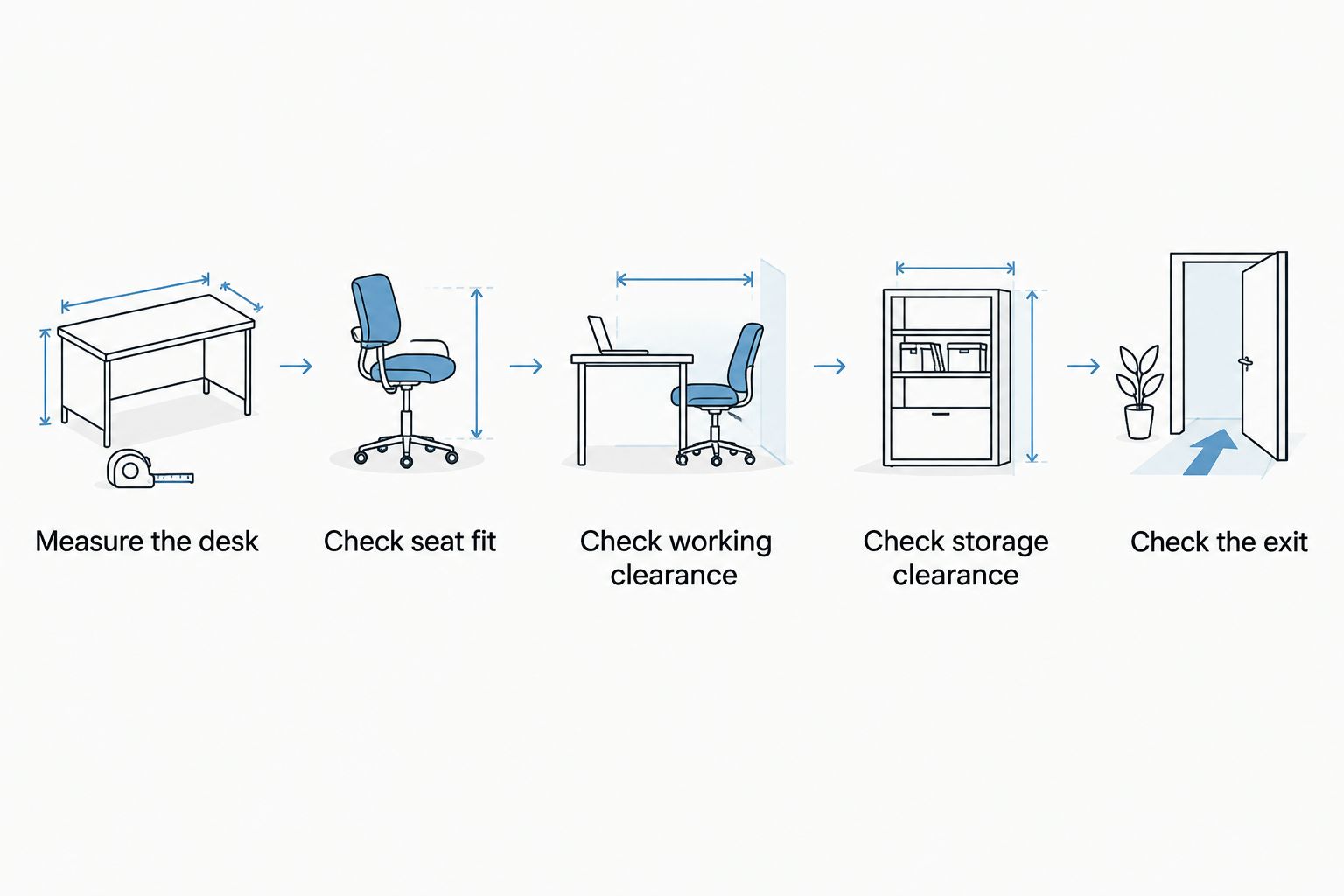
A room can accommodate the chair while the desk still prevents a useful working position. Reject a configuration that forces you to reach around the desk edge or sit too far from the keyboard.
Product options to inspect more closely
These options represent conventional task seating, adjustable saddle seating, and a dedicated Surgeon Chair. Compare their current specifications with your measurement sheet before selecting a configuration.


How the 2026 ranking works
This shortlist separates chairs by seating format, named features, intended users, and task. It is not a measured smallest-footprint ranking or a clinical outcome comparison.
The conventional mesh chair leads for general desk work; adjustable saddle seating serves buyers who specifically want that format. Petite seating and Surgeon Chairs occupy narrower use cases because their intended users and tasks differ.
Which ergonomic home office chair should you choose?
Start with the Mid-Back Black Mesh Swivel Ergonomic Task Office Chair with Flip-Up Arms if you want a conventional ergonomic home office chair. It gives you a clear first candidate to assess against the desk-clearance checklist.
Choose the USA Patented Twin Tiltable Saddle Stool when adjustable saddle fit is your priority. Choose the petite option only within its intended-user guidance, and keep the Surgeon Chair on a separate precision-work shortlist.
Sithealthier's ergonomic home office chair choices cover different seating needs; the useful comparison is task fit, not the longest feature list. In 2026, a chair that fits your room but obstructs your work is still the wrong chair.
FAQ
What's the best ergonomic home office chair for a small space?
The Mid-Back Black Mesh Swivel Ergonomic Task Office Chair with Flip-Up Arms is the default shortlist choice here for conventional desk work. Confirm its overall dimensions and desk clearance before choosing it.
Is a saddle stool better than an office chair for a small room?
A saddle stool is not automatically better for a small room. Compare the complete base, working position, and storage clearance, then decide whether saddle seating suits you.
Will flip-up arms let my chair fit under the desk?
Flip-up arms address arm interference, not every clearance issue. The backrest, seat height, desk apron, and base still determine whether the chair tucks away.
Which saddle stool should a petite home-office buyer consider?
The Small Ergonomic Saddle Seat Stool for Petite Women is a candidate for users approximately 5 feet 2 inches or shorter and weighing 125 lbs or less. Confirm the selected height range and seat fit before ordering.
Should I use a Surgeon Chair for working from home?
A Surgeon Chair belongs on your shortlist when the home workstation involves the precision task it is designed for. For documentation and ordinary keyboard work, assess a conventional task chair first.
Does a saddle chair cure back pain?
A saddle chair is seating equipment, not a guaranteed treatment for back pain. Choose it for fit and task requirements, and seek qualified medical advice for persistent symptoms.
What should I measure before ordering an office chair?
Measure the desk opening, underside clearance, working area, storage area, and exit path. Compare those measurements with the exact chair configuration, including its base and supports.
One last thing
The smallest-looking seat can still have an inconvenient base. Mark the proposed chair's full footprint on the floor, then check your route into and out of the desk before you order.
Keep that measurement sheet when comparing Sithealthier seating. It gives you a consistent way to reject unsuitable configurations without relying on photographs.
Leave a comment