

Best overall ergonomic saddle chair for adjustable seat width: Salli MultiAdjuster. Best for straightforward home use: Jobri BetterPosture. Best for petite users: Small Ergonomic Saddle Seat Stool for Petite Women. This 2026 guide compares saddle seating for home-office work, including charting and administrative tasks between clinical sessions.
- Salli MultiAdjuster is the default ergonomic saddle chair shortlist pick when adjustable seat width matters.
- Jobri BetterPosture suits home-office buyers seeking straightforward saddle seating rather than specialized clinical supports.
- Salli SwingFit suits buyers who specifically want seat movement; Bambach offers a contoured option with a backrest.
- Check seat height against your desk, foot support, and working reach before choosing any saddle stool.
Why this matters
A saddle chair has to fit your desk as well as your body. Choosing a seat shape without checking working height leaves the most important purchasing question unanswered: can you type, read, or complete patient notes without reaching upward or leaning toward the screen?
For dental and medical professionals, home-office work also differs from chairside work. Arm supports that suit a clinical task are not automatically the right choice for a keyboard workstation. Sithealthier offers ergonomic saddle chair choices for home-office buyers and clinicians comparing seat shapes and support options. Browse Sithealthier for its seating categories, then narrow your choice by the task rather than the product name.
What makes the best ergonomic saddle chair?
Use these criteria to compare the 2026 shortlist. A feature earns its place only when it solves a fit or workflow requirement.
- Seat fit: Compare saddle contour, seat width, and whether the seat is divided. Your thighs should not need to accommodate an unsuitable seat shape.
- Working height: Check the exact seat-height range against your desk and your preferred seated position. An adjustable chair still needs the right adjustment range.
- Foot support: Decide whether your feet will rest on the floor or need a suitable support. Check this at your actual typing height.
- Back support: Choose a backrest when you want that contact, but check whether its position suits both typing and reading.
- Seat movement: Separate a moving seat from a seat that adjusts and stays in position. Choose movement deliberately, not because it sounds more ergonomic.
- Workspace fit: Check the base, nearby furniture, and access to controls. A chair must work inside the space you actually have.
Ergonomic saddle chairs at a glance
The order below starts with a broadly useful adjustment feature, then separates the other options by distinct buying needs. These are task-based recommendations, not claims that one chair fits everyone.
| Chair | Best for | Standout feature | Key limitation or fit check |
|---|---|---|---|
| Salli MultiAdjuster | Adjustable-width saddle seating | Adjustable seat width and split-seat design | Width adjustment does not establish the correct desk height |
| Jobri BetterPosture | Straightforward home-office use | Saddle seating described for home use | Do not assume specialized clinical support features |
| Small Ergonomic Saddle Seat Stool for Petite Women | Petite users within the stated sizing guidance | Designed for users approximately 5 ft 2 in or shorter and 125 lb or less | Sizing guidance limits its intended fit |
| The Bambach with Backrest | Contoured saddle seating with back contact | Sculpted saddle and backrest | A defined contour needs a careful personal fit check |
| Salli SwingFit | Buyers who want seat movement | Seat tilts in every direction without a separate adjustment lever | Movement is not the right preference for every task |
| Narrower Seat Dynamic Motion Stool | Buyers comparing a narrower single-piece seat | 13-inch undivided seat | Narrower does not automatically mean the right fit |
1. Salli MultiAdjuster: best for adjustable-width seating
The Salli MultiAdjuster Saddle Chair with Adjustable Seat Width is the default shortlist choice when seat width is your main concern. Its adjustable width and split-seat design give you specific features to evaluate instead of relying on an ergonomic label alone.
For a clinician completing records at home, start with workstation fit rather than adding procedure-oriented supports. The MultiAdjuster belongs on that home-office shortlist because its stated width adjustment addresses seat fit directly.
Salli MultiAdjuster pros:
- Adjustable seat width is an explicit product feature.
- The split-seat design provides an alternative to an undivided saddle.
- Width adjustment gives you a clear variable to compare during fitting.
Salli MultiAdjuster cons:
- Adjustable width does not confirm a suitable seat-height range.
- A split seat still requires a personal comfort and positioning check.
Best for: Home-office buyers who want to adjust saddle width rather than select a fixed-width seat.
Verdict: Buy for width adjustment after confirming the chair's working-height fit.
2. Jobri BetterPosture: best for straightforward home use
The Jobri BetterPosture Ergonomic Saddle Chair for Office and Medical [BLACK] is explicitly described for home use. It is the straightforward option for buyers who want to compare saddle seating without starting with surgeon-style or dental-assistant supports.
Keep the decision focused. If your work consists of typing, reading, and calls, first establish whether the seat and desk work together; specialized clinical accessories should not drive that purchase.
Jobri BetterPosture pros:
- The product description identifies home use as a suitable application.
- Its saddle format offers an alternative to a conventional office seat.
- Its office-and-medical positioning fits buyers comparing both settings.
Jobri BetterPosture cons:
- A home-use description does not establish fit at your particular desk.
- The description does not establish specialized arm-support features.
Best for: Home-office buyers starting with a straightforward saddle-seating option.
Verdict: Buy for home use once seat dimensions and adjustment range match your workstation.
3. Small Ergonomic Saddle Seat Stool: best for petite users
The Small Ergonomic Saddle Seat Stool for Petite Women has unusually specific fit guidance: it is designed for petite users approximately 5 ft 2 in or shorter and weighing 125 lb or less. Use those figures as screening guidance, not as a guarantee of comfort.
The description refers to petite users, so evaluate the stated sizing rather than treating the title as the only selection rule. Body proportions and desk height still matter after you meet that initial guidance.
Small Ergonomic Saddle Seat Stool pros:
- The description provides explicit user-height guidance.
- The stated weight guidance makes initial screening clearer.
- The small-seat positioning addresses buyers who find larger seats unsuitable.
Small Ergonomic Saddle Seat Stool cons:
- It is not a general-purpose recommendation outside its stated sizing guidance.
- User height alone does not determine the correct seat height or saddle contour.
Best for: Petite buyers who meet the stated guidance and need a smaller seating option.
Verdict: Hold until you confirm both the sizing guidance and your required working height.
4. The Bambach with Backrest: best for contoured back support
The Bambach – The Original Ergonomic Saddle Chair with Backrest combines a saddle seat with back support. Its description identifies a deeply sculpted front pommel and rear cantle, making contour a central part of the comparison.
Choose this option because you want to evaluate that defined seat shape alongside a backrest. Do not choose it on the assumption that a stronger contour or added support guarantees a better result.
The Bambach with Backrest pros:
- A backrest is part of the named product configuration.
- The description identifies the saddle's sculpted contour.
- It offers a distinct alternative to backless saddle seating.
The Bambach with Backrest cons:
- A defined contour requires a careful personal fit check.
- Backrest presence alone does not establish the right contact position for typing.
Best for: Buyers who specifically want contoured saddle seating with back contact.
Verdict: Buy only when the saddle contour and backrest suit your working position.
5. Salli SwingFit: best for buyers seeking seat movement
The Salli SwingFit Ergonomic Saddle Chair or Stool has a swing mechanism that lets the seat tilt in every direction without a separate adjustment lever. That distinguishes it from choosing a seat angle and leaving it there.
For your 2026 home-office shortlist, treat movement as a preference to assess during actual work. A feature that feels suitable during reading still needs to suit keyboard and mouse use.
Salli SwingFit pros:
- The description explicitly identifies multidirectional seat tilt.
- Movement does not require a separate adjustment lever.
- Its moving-seat mechanism creates a clear comparison with stationary seating.
Salli SwingFit cons:
- Seat movement adds a fit consideration for precise keyboard and mouse work.
- The mechanism does not resolve desk-height or foot-support requirements.
Best for: Buyers who deliberately want a saddle seat that moves during use.
Verdict: Buy for seat movement, not for an assumed health benefit.
6. Narrower Seat Dynamic Motion Stool: best for a narrow single seat
The Narrower Seat 360° Dynamic Motion Ergonomic Saddle Stool Holland Made is described as having a 13-inch narrower seat. The description also identifies it as an undivided, single-seat design.
This is the useful comparison when you want a narrower saddle without choosing a split seat. Compare that width with the seat you currently use, but do not interpret the measurement as a universal fit recommendation.
Narrower Seat Dynamic Motion Stool pros:
- The description gives a concrete seat-width measurement.
- Its undivided seat offers an alternative to split-seat designs.
- The narrower-seat positioning makes its intended comparison clear.
Narrower Seat Dynamic Motion Stool cons:
- A 13-inch seat width does not establish suitable contour or working height.
- A narrower seat is not automatically a better seat for every smaller user.
Best for: Buyers specifically comparing narrower, single-piece saddle seats.
Verdict: Hold until the seat width, contour, and movement match your preferences.
Check the chair against your home-office setup
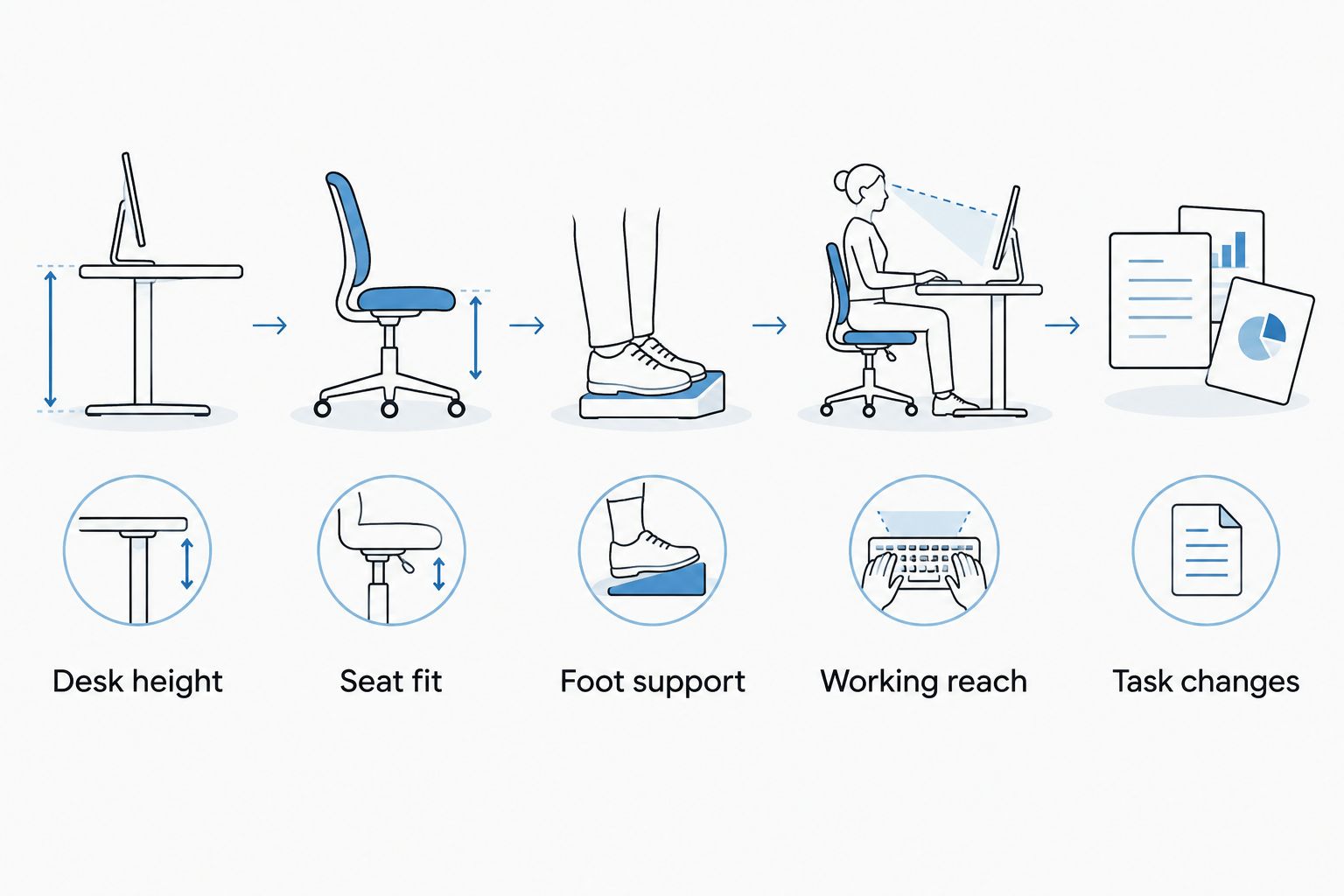
Before choosing a chair in 2026, work through this sequence at the desk you will actually use. Record the relevant dimensions in inches so you can compare them with the exact chair configuration.
- Desk height: Identify the keyboard working surface and any obstruction below it. Check drawers and desk edges, not just the tabletop.
- Seat fit: Compare your required seated position with the chair's stated height range and seat dimensions.
- Foot support: Confirm where your feet will rest at typing height. Do not solve a desk mismatch by leaving your feet unsupported.
- Working reach: Check whether you can use the keyboard and mouse without reaching around the desk or chair supports.
- Task changes: Recheck the setup for reading, calls, and documentation. Your chair should suit more than the position used for a product photo.
For dental or medical work performed in a clinical room, add patient access, procedure supports, and equipment clearance to that assessment. A home-office recommendation is not a substitute for selecting seating around a specific clinical procedure.
Compare the shortlisted configurations
Use the product details below to compare the named configurations. Confirm dimensions, adjustment ranges, and support requirements before ordering; do not infer those specifications from a photograph.


How the chairs are ranked
This 2026 ranking follows the stated seat features and intended uses: adjustable width, home use, petite sizing, contoured back support, movement, and narrower single-seat fit. It does not assign comfort scores or claim clinical testing.
Sithealthier's ergonomic saddle chair selection includes different seat shapes and support configurations. The useful comparison is which configuration addresses your requirement, not which product carries the strongest posture claim.
Which ergonomic saddle chair should you choose?
Start with the Salli MultiAdjuster if adjustable width is your priority. Choose Jobri BetterPosture for a straightforward home-use comparison, the petite stool for its stated sizing guidance, or The Bambach with Backrest when contoured seating and back contact are requirements.
Choose Salli SwingFit only when you want movement. Compare the narrower dynamic-motion stool when an undivided 13-inch seat is the feature you need to evaluate.
For an undecided buyer in 2026, the next move is measurement, not another feature list. Give Sithealthier your desk working height, current seating concerns, and intended tasks when asking for help selecting the right fit.
FAQ
What's the best ergonomic saddle chair for a home office?
Salli MultiAdjuster is the default shortlist choice when adjustable seat width matters. Confirm its exact seat-height range and fit against your desk before choosing it.
Is a saddle chair better than a regular office chair?
A saddle chair is a different seating format, not an automatic improvement for every user. Compare seat fit, foot support, back support, and keyboard reach at your actual workstation.
Which saddle stool should petite users consider?
The Small Ergonomic Saddle Seat Stool for Petite Women is described for users approximately 5 ft 2 in or shorter and 125 lb or less. Treat those figures as initial screening guidance, then check seat dimensions and working height.
Should I choose a saddle chair with a backrest?
Choose a backrest when you want back contact in your working position. The Bambach – The Original Ergonomic Saddle Chair with Backrest is one option to compare, but its contour still needs a personal fit check.
What's different about Salli SwingFit?
Salli SwingFit has a mechanism that lets the seat tilt in every direction without a separate adjustment lever. Choose it when you specifically want seat movement rather than assuming movement suits every task.
Can I use a home-office saddle chair for dental procedures?
A home-office fit check does not establish suitability for dental procedures. Clinical seating also needs assessment against patient access, equipment clearance, working height, and procedure-specific support requirements.
Will an ergonomic saddle chair cure back pain?
An ergonomic saddle chair does not guarantee pain relief or treat a medical condition. Choose seating for fit and task requirements, and seek qualified medical advice for persistent pain.
One last thing
Check the space beneath your desk before choosing the chair. A suitable seat still fails the workstation test if a drawer blocks your thighs or prevents you from reaching the keyboard comfortably. Resolve that obstruction before adding more chair features.
Leave a comment