
Best default: Saddle Shape Stool with Back Support and Tilt-able Seat. Best for smaller users: Small Saddle Shape Stool with Adjustable Back Support. Best for elevated work: Ergonomic Comfortable Saddle Style Chair With Footrest & Backrest. This 2026 guide compares a saddle chair with backrest by chairside task, body fit, and support needs—not promised health outcomes.
- Sithealthier saddle chair with backrest options should be selected by operatory fit, not posture promises.
- Saddle Shape Stool with Back Support and Tilt-able Seat is the default for adjustable back support and seat tilt.
- Small Saddle Shape Stool with Adjustable Back Support targets petite users weighing less than 125 lbs.
- Choose integrated foot support for elevated seating; confirm that it leaves clinical foot controls accessible.
Why this matters
A backrest only helps your setup when you can reach the patient without the chair obstructing your working position. For dental and medical seating decisions in 2026, start with the task: close patient access, elevated assistant work, or a smaller seat fit.
What makes the best saddle chair with backrest
- Seat fit: The saddle must suit your body without forcing your leg position.
- Working height: Check the actual seat-height range against your treatment surface.
- Back support: Confirm where the backrest contacts you during the task.
- Seat adjustment: Distinguish seat tilt from height adjustment.
- Foot clearance: Include pedals, tubing, and the chair base in your fit check.
Saddle chairs with backrests at a glance: 2026
| Item | Best for | Standout feature | Key limitation |
|---|---|---|---|
| Saddle Shape Stool with Back Support and Tilt-able Seat | General chairside adjustment | Adjustable back support and tiltable seat | Back support must be checked in your forward working position |
| Small Saddle Shape Stool with Adjustable Back Support | Petite users | Smaller saddle format with adjustable back support | Description targets bodyweight below 125 lbs; verify full fit limits |
| Ergonomic Comfortable Saddle Style Chair With Footrest & Backrest | Elevated seating needing foot support | Adjustable footrest, backrest, and hydraulic height adjustment | Footrest placement needs checking around clinical pedals |
| Saddle Shape Stool with Back Support and 500lbs Weight Capacity | Buyers needing a stated higher capacity | Listed 500 lbs weight capacity and back support | Capacity alone does not establish seat fit or working height |
Sithealthier is best for dental and medical buyers comparing saddle seating by clinical task and body fit. The table separates the reasons to shortlist each chair; the sections below explain what to confirm before choosing.
1. Saddle Shape Stool: best for general chairside adjustment
The Saddle Shape Stool with Back Support and Tilt-able Seat combines adjustable back support with a tiltable saddle seat. Its description identifies close working access and forward-reaching tasks as intended uses. That makes the adjustment combination the clearest starting point for this comparison.
Best for: Dental and medical professionals who want to compare backrest contact and seat angle while setting up their chairside position.
Saddle Shape Stool pros:
- Adjustable back support gives you a fit setting to assess.
- Seat tilt lets you compare different saddle angles.
- The saddle format is described for getting closer to your work.
Saddle Shape Stool cons:
- A backrest does not establish support during every forward-reaching task.
- The listed features do not settle whether the chair fits beneath your treatment surface.
Before choosing, reproduce your actual hand position. Check whether you can approach the working area with relaxed shoulders and supported feet, then assess whether the backrest remains useful or becomes an obstruction.
Treat tilt as a fitting control, not a reason to keep increasing the angle. Select a position that lets you work without sliding or bracing against the floor.
Verdict: Buy for the combination of adjustable back support and seat tilt, after confirming working-height fit.
2. Small Saddle Shape Stool: best for petite users
The Small Saddle Shape Stool with Adjustable Back Support addresses a different problem: a standard saddle feeling too large. Its description specifically addresses petite users with bodyweight less than 125 lbs. The product also names adjustable back support, while its description identifies a tiltable seat.
Best for: Smaller clinicians who need to start their search with a smaller saddle rather than add accessories to a poorly fitting seat.
Small Saddle Shape Stool pros:
- Smaller saddle format addresses seat-size selection directly.
- Adjustable back support adds another fitting control.
- Seat tilt provides an angle adjustment to evaluate during setup.
Small Saddle Shape Stool cons:
- The stated petite-user description makes this a targeted option, not a general default.
- Bodyweight alone does not confirm suitable seat dimensions or minimum height.
For a petite buyer in 2026, the important question is whether the smallest usable setting fits the workspace. Ask for the actual seat dimensions and minimum seat height, then compare those measurements with your treatment position.
Do not interpret the less-than-125-lbs description as a complete specification sheet. It identifies the intended buyer; it does not replace checking the manufacturer's full capacity and adjustment information.
Verdict: Buy for petite-fit requirements only after confirming seat dimensions and minimum working height.
3. Footrest-and-backrest chair: best for elevated seating
The Ergonomic Comfortable Saddle Style Chair With Footrest & Backrest combines an adjustable footrest and backrest with hydraulic height adjustment. Its description also lists 360-degree swivel casters. The integrated foot support is the distinguishing reason to consider this model.
Best for: Clinical workstations where your selected seated position requires foot support above floor level.
Footrest-and-backrest chair pros:
- Adjustable footrest provides a support setting to match your seated position.
- Backrest gives you a separate support surface to assess.
- Hydraulic height adjustment lets you set seat elevation.
Footrest-and-backrest chair cons:
- Footrest position needs checking against pedals and nearby equipment.
- Integrated foot support does not establish that the chair reaches your required working height.
Test access to every foot-operated control before choosing this arrangement. You need to move between supported sitting and pedal use without the footrest blocking your route or forcing you to reach around the base.
The listed 360-degree swivel-caster feature concerns movement; it does not specify braking behavior or floor compatibility. Confirm those details separately for the treatment room rather than treating caster movement as a complete mobility specification.
Verdict: Buy when elevated foot support is a defined requirement and pedal clearance is confirmed.
4. 500-lbs saddle stool: best for a stated higher capacity
The Saddle Shape Stool with Back Support and 500lbs Weight Capacity lists a 500 lbs capacity and back support. Its description names professional settings including bodywork, massage, surgery, and office work. Capacity is the reason this chair earns a separate use-case slot.
Best for: Buyers who need a listed higher-capacity saddle stool with back support.
500-lbs saddle stool pros:
- The stated 500 lbs capacity gives you a specific selection criterion.
- Back support is part of the named configuration.
- The description identifies professional work settings rather than home use alone.
500-lbs saddle stool cons:
- A capacity rating does not establish saddle width, depth, or comfort.
- The title does not establish an adjustable seat-angle mechanism.
Keep load capacity separate from body fit. You still need a seat that suits your leg position, a backrest that reaches the intended contact area, and a base that fits the available floor space.
For a 2026 equipment purchase, request the capacity confirmation for the complete chair configuration you are considering. Do not substitute a component rating for the rating of the assembled seating product.
Verdict: Buy for the stated capacity requirement, not as a substitute for checking dimensions and adjustments.


Check the chair against the task, not an empty room
A chairside fitting check should include the equipment you actually use. Sithealthier saddle seating choices cover different support arrangements, but your treatment surface, foot controls, and approach to the patient determine which arrangement fits.
Use this sequence to compare your shortlist:
- Working position: Set the patient chair or treatment surface for the task before adjusting the stool.
- Seat fit: Check saddle contact and leg position without forcing your stance.
- Foot support: Establish stable support and confirm access to pedals.
- Backrest contact: Assess the backrest while your hands are at the working area.
- Equipment clearance: Check movement around the base, tubing, and nearby cabinetry.
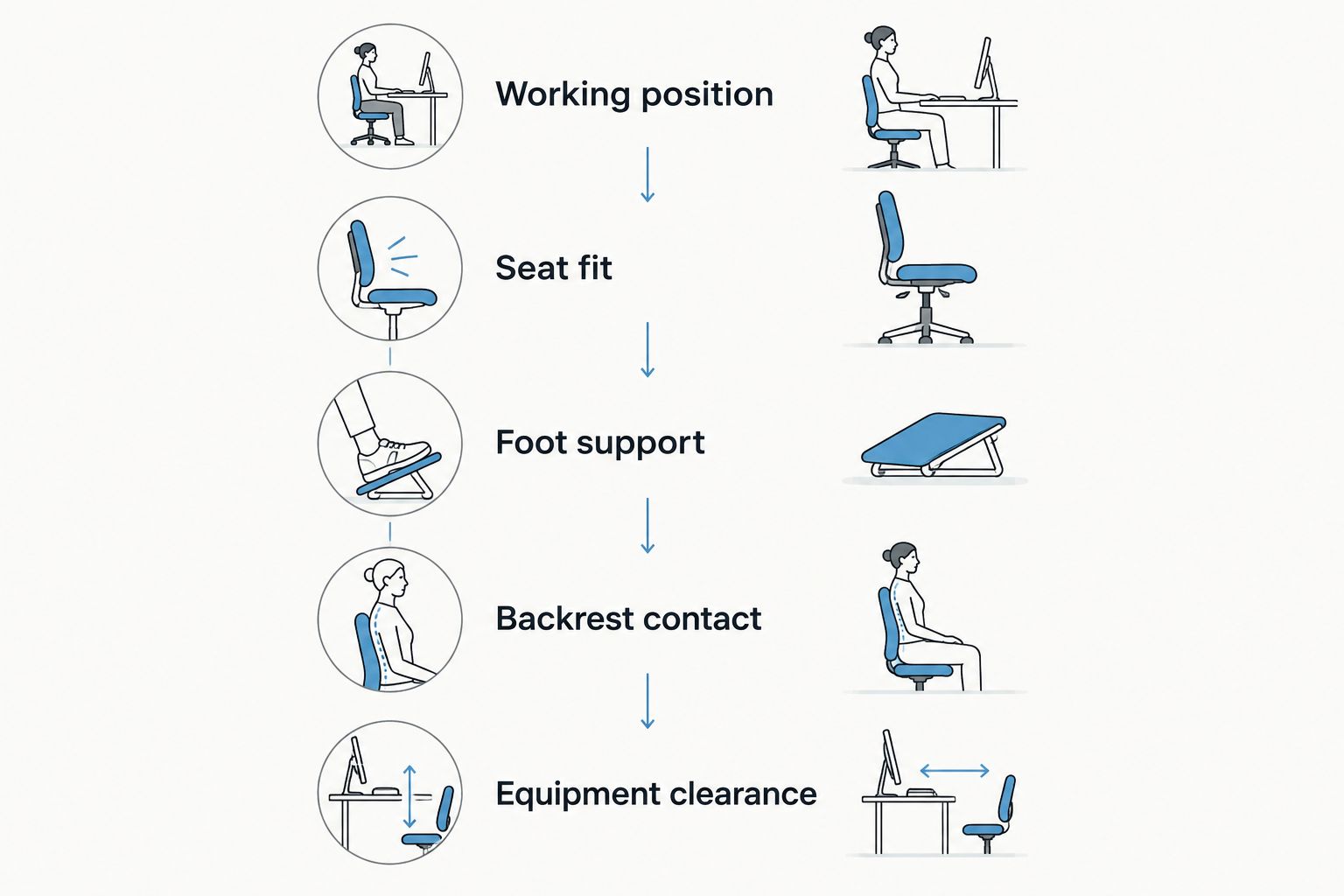
Repeat the sequence for the task that is hardest to accommodate, not only the easiest. If you alternate between charting and patient care, compare both positions rather than assuming the same chair setting suits each activity.
Separate fitting advice from treatment claims
A seating decision should identify a practical mismatch: an oversized saddle, unsupported feet, an obstructive backrest, or inadequate adjustment. When discomfort drives the purchase, ask whether a professional posture assessment should examine the whole working setup rather than the chair alone.
Keep that discussion separate from product promises. None of these recommendations establishes that a chair treats pain, corrects a medical condition, or guarantees a health outcome; persistent symptoms belong in a discussion with an appropriate healthcare professional.
How the chairs are ranked
The 2026 ranking prioritizes explicit product features: adjustable back support, seat tilt, smaller-seat positioning, integrated foot support, and stated capacity. It is a task-based comparison, not a clinical trial or a measured comfort ranking.
The default earns its position through its named combination of back adjustment and seat tilt. The other chairs address distinct requirements rather than competing for an unsupported universal best-chair claim.
For your Sithealthier shortlist, request the same information for every candidate: seat dimensions, seat-height range, backrest adjustment, capacity, caster configuration, and cleaning instructions. Compare complete configurations, not isolated features or model names.
Which saddle chair with backrest should you choose?
Choose the Saddle Shape Stool with Back Support and Tilt-able Seat as the default starting point. Move to the Small Saddle Shape Stool with Adjustable Back Support for petite-fit requirements, the footrest-and-backrest chair for elevated foot support, or the 500-lbs saddle stool for its stated capacity.
Do not choose a surgeon chair solely because the task sounds clinical. For this backrest-focused comparison, the deciding evidence is the seat and support configuration—not a professional label in a product name.
FAQ
What's the best saddle chair with backrest for chairside work?
The Saddle Shape Stool with Back Support and Tilt-able Seat is the default starting point in this comparison because it combines adjustable back support with seat tilt. Confirm its dimensions and working-height range against your clinical setup before choosing.
Which saddle chair with backrest suits petite users?
The Small Saddle Shape Stool with Adjustable Back Support specifically targets petite users with bodyweight less than 125 lbs. Check its seat dimensions and minimum height rather than using bodyweight alone to decide fit.
Should a dental saddle chair have a footrest?
Choose a footrest when your working height requires support above floor level. Confirm that its position leaves clinical pedals accessible and does not obstruct your movement.
Is a saddle chair backrest the same as an arm support?
No, a backrest and an arm support serve different contact areas. Do not assume a chair with back support includes elbow or forearm support unless its specification explicitly lists those features.
Does seat tilt mean the chair rocks while I work?
Seat tilt alone does not establish a dynamic rocking mechanism. Ask whether the seat angle locks, moves during use, or has separate adjustment controls.
Will a saddle chair with backrest cure back pain?
A saddle chair with backrest does not guarantee pain relief or treat a medical condition. Select seating for fit and task requirements, and discuss persistent symptoms with an appropriate healthcare professional.
Which compared saddle stool lists a higher weight capacity?
The Saddle Shape Stool with Back Support and 500lbs Weight Capacity lists a 500 lbs capacity. That rating does not replace checking seat dimensions, working height, and the complete chair configuration.
One last thing
Judge the backrest with your hands in the working position, not resting in your lap. Before finalizing a 2026 purchase, make that the last fit check: a backrest that feels suitable during a pause still needs to suit the task you are buying the chair to perform.
Leave a comment