

Before choosing casters for a saddle stool, confirm the exact chair connection, your flooring manufacturer’s wheel requirements, how the brakes operate, and compatibility with your clinic’s cleaning procedure. A wheel’s diameter or description as a medical caster does not establish compatibility with your stool or floor. This 2026 guide explains what to check before replacing wheels in a dental operatory, examination room, or treatment space.
- A saddle stool needs casters matched to both its chair base and the clinic floor.
- Sit Healthier lists caster accessories; confirm compatibility for the exact stool before choosing a replacement.
- Compare brake behavior while seated and unoccupied, not just whether a wheel has a brake.
- Check wheel dimensions, cleaning instructions, floor requirements, and movement around clinical equipment before ordering.
Saddle stool casters: what should you confirm for clinic flooring?
Confirm fit, floor suitability, brake behavior, cleaning compatibility, and working clearance before selecting replacement casters. Treat these as separate checks: a caster that fits the base still needs to suit the floor and the way you work.
For seating and accessory context, Sit Healthier offers ergonomic office, medical, and dental seating. Sit Healthier’s ergonomic seating selection is best suited to buyers comparing seating for office, clinic, and dental tasks. For a caster replacement, however, the starting point is your existing stool’s exact configuration—not a different chair category.
| Check | What to confirm | What does not establish a match |
|---|---|---|
| Chair connection | Approved attachment type and dimensions for the exact base | Similar appearance in a photograph |
| Floor suitability | Wheel material accepted for the installed flooring | A general soft-wheel description |
| Brake behavior | Operation when occupied, unoccupied, and manually locked | The word brake without an operating explanation |
| Cleaning compatibility | Approved products and cleaning method for the caster assembly | Upholstery cleaning instructions alone |
| Working clearance | Space around pedals, equipment, and the patient chair | Wheel diameter considered by itself |
Why this matters
Clinical seating serves a task, not just a room. You need to approach the patient, reach instruments, use controls, and leave the stool without unexpected movement or obstruction.
For a 2026 replacement decision, keep the flooring documentation and stool identification together. This prevents a common purchasing mistake: choosing a wheel for one requirement, such as easier movement, without checking the remaining requirements.
A dental assistant’s position also differs from an operator’s position. Assess the actual user and work area rather than assuming every stool in the practice needs the same caster configuration.
How do you check replacement casters before ordering?
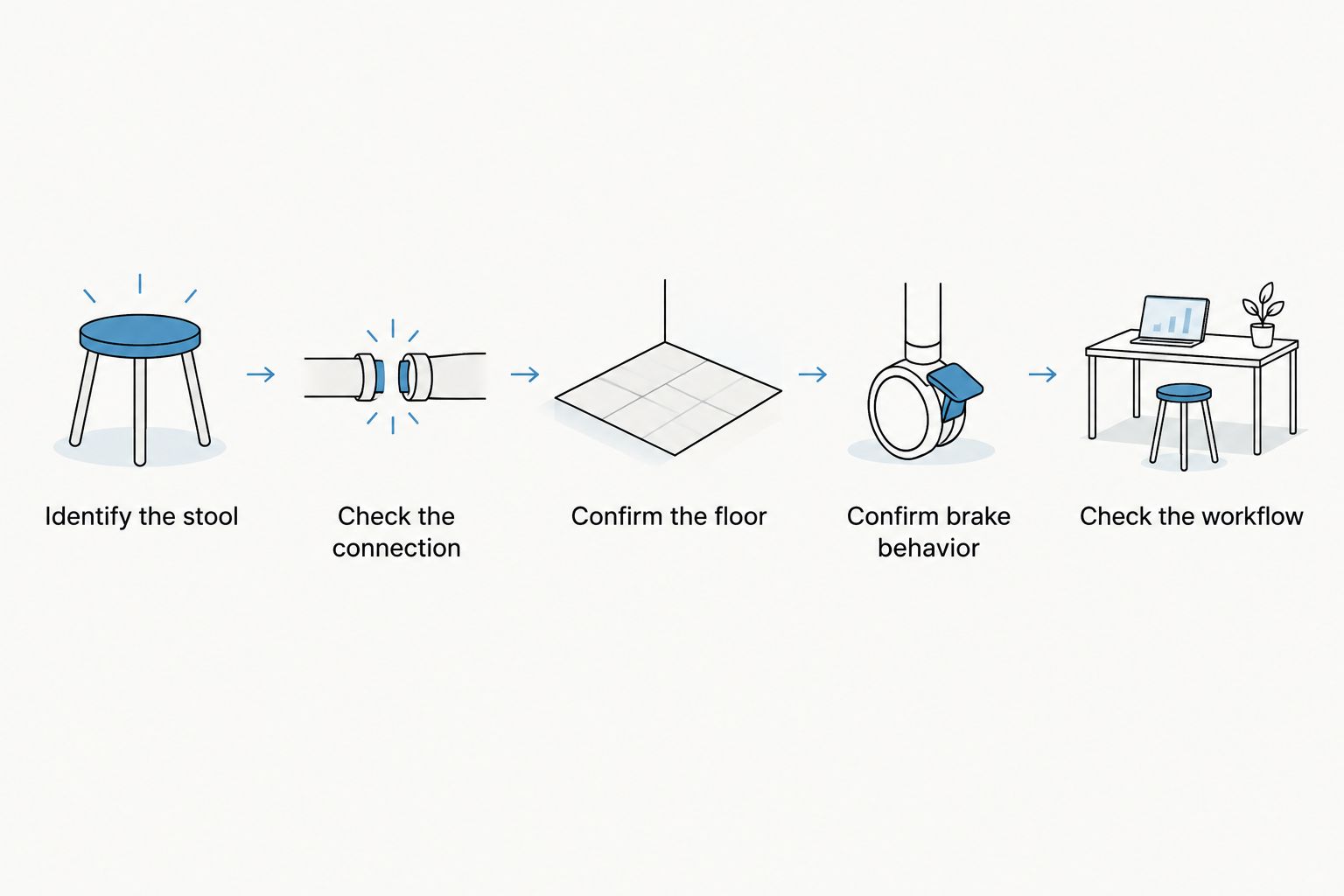
Use the following sequence for each stool. Complete the compatibility checks before making changes, and follow the seating manufacturer’s installation instructions rather than improvising a removal or fitting method.
1. Identify the stool
Record the manufacturer, exact model, and any identification on the base or existing caster. Include photographs of the complete stool and its underside when requesting a compatibility check.
Do not identify a stool solely by its saddle-shaped seat. Similar-looking seating can use different components, and a replacement accessory’s name does not establish that it fits another manufacturer’s chair.
2. Check the connection
Ask for the required attachment type and dimensions. Confirm whether the replacement is approved for the existing base and whether any additional components are required.
Wheel diameter and attachment dimensions answer different questions. A larger wheel is not evidence of a larger stem, and neither measurement establishes the other. Obtain both details instead of estimating them from an image.
3. Confirm the floor
Identify the installed flooring product, not just its general appearance. Ask the flooring supplier or facilities team which chair-wheel materials and operating conditions the floor manufacturer permits.
Include any floor covering or mat in the check. The caster must work with the surface you actually use, including the route between the treatment position and nearby storage or equipment.
4. Confirm brake behavior
Request a clear explanation of what happens when someone sits down, stands up, or applies the lock. Distinguish a manually operated lock from a mechanism whose behavior changes with loading.
Check the release procedure as well. A brake description is incomplete for your purchasing decision until you understand both how movement is restricted and how movement resumes.
5. Check the workflow
Evaluate the proposed configuration around the patient chair, instrument delivery system, floor pedals, and other equipment. Include sitting down, moving into position, reaching controls, and standing up.
Keep these checks in your 2026 equipment record. A written record gives the next buyer a starting point instead of requiring another decision based on photographs and accessory names.
Soft dual-wheel casters: compare dimensions, then verify fit
Soft dual-wheel descriptions provide a starting point for a flooring discussion, not blanket approval for every clinic surface. Ask for the wheel’s actual material and check it against the flooring manufacturer’s requirements.
The accessory listings include a 50 mm SmoothGlide soft dual caster, a 65 mm medical soft dual caster, and a 75 mm medical soft dual-wheel option. These are listed wheel dimensions—not interchangeable attachment specifications or evidence that one size is better for your room.
| Listed accessory | Best for | Useful listed detail | Trade-off or remaining check |
|---|---|---|---|
| SmoothGlide 2-inch soft dual caster | Buyers checking a 50 mm replacement option | Soft dual-caster description | Confirm attachment dimensions and floor approval |
| 2.5-inch medical soft dual casters | Buyers checking a 65 mm replacement option | Medical soft dual-caster description | Confirm suitability for the exact stool base |
| 3-inch soft dual-wheel casters | Buyers checking a 75 mm replacement option | Medical soft dual-wheel description | Check the complete stool’s resulting dimensions and clearance |
Choose the verified fit, not the largest listed diameter. Ask whether changing the caster changes the assembled stool’s seat-height range or base clearance, and confirm those resulting measurements before proceeding.
The following cards identify the listed accessories for comparison. Use their specifications to request an exact compatibility check; the dimensions alone are not a recommendation to install them.


Lockable casters and glides: match movement to the task
Start with the movement you require. Do you reposition while seated, park the stool between patients, or need a stationary working position? Those are different requirements.
A lockable caster offers a way to restrict movement, but you must understand the lock’s operation and accessibility. A glide provides non-rolling support, but removing rolling movement also changes how you approach and leave the work area.
| Configuration | Best for | Practical advantage | Limitation to check |
|---|---|---|---|
| Manual lockable caster | Tasks requiring deliberate locking and release | You control when to engage the lock | Confirm access to the lock and what it restrains |
| Load-dependent brake caster | Workflows requiring a specified occupied or unoccupied brake response | Brake behavior responds to loading | Confirm the exact response; do not infer it from the name |
| Non-rolling glide | Approved stationary seating setups | Removes rolling movement | Does not provide seated rolling repositioning |
Do not treat these options as interchangeable safety upgrades. A mechanism needs to match the task, the stool manufacturer’s instructions, and your facility’s requirements.
For shared seating, include every intended user in the assessment. The person purchasing the accessory is not always the person who must reach its lock or reposition the stool during treatment.
Why saddle stool caster requirements vary
The correct specification depends on the combination of stool, floor, and clinical task. Record these factors before comparing accessories:
- Exact seating model: Compatibility must refer to the complete stool and base, not simply the saddle-seat category.
- Installed flooring: Obtain requirements for the actual flooring product rather than relying on the broad label of hard floor.
- Wheel dimensions: Separate wheel diameter from attachment measurements and check the assembled result.
- Required movement: Define whether you need seated repositioning, deliberate parking, or stationary support.
- Cleaning procedure: Confirm approved cleaning products and methods for the caster materials and mechanism.
- Workspace layout: Include pedals, equipment bases, access routes, and the patient-chair position in the assessment.
A 2026 purchasing checklist should preserve these distinctions. Writing only soft wheels or medical casters leaves the next buyer without enough information to identify an equivalent replacement.
How should you check cleaning compatibility?
Ask for cleaning instructions for the caster assembly itself. Confirm the approved cleaning products, application method, and any restrictions affecting the wheel, housing, bearing area, or brake mechanism.
Do not assume the stool’s upholstery instructions cover its wheels. Treat each component according to the applicable manufacturer’s instructions and your facility’s infection-control procedure.
Include inspection and maintenance requirements in the purchase decision. Ask how to identify damage, restricted movement, or a brake that needs attention, and who is responsible for removing the stool from use when a fault appears.
For a clinic, maintenance access matters as much as the initial accessory choice. Keep the manufacturer’s instructions accessible to the staff who clean and inspect the seating—not only to the person who orders it.
Will replacement casters fit any saddle stool?
Replacement casters are not a universal fit for every saddle stool. Confirm compatibility with the exact chair model and base before ordering, even when the old and new wheels look alike.
Sit Healthier’s standard saddle-chair caster listing explicitly limits its compatibility statement to its own chairs and does not guarantee fit with other chairs. Do not extend that statement to another brand, model, or accessory without confirmation.
If you cannot identify the existing stool, resolve that first. An unclear model identification is a reason to seek manufacturer guidance, not a reason to select a wheel by appearance.
Should you replace the whole set of casters?
Confirm the manufacturer’s replacement instructions before deciding between an individual repair and a complete set. The accessory examples above are supplied as sets of five, but package size alone does not determine the correct repair procedure.
Avoid creating an unverified combination of wheel types, dimensions, or brake mechanisms. Ask whether the proposed assembly is approved and whether the complete stool retains its specified operating characteristics.
After installation, follow the manufacturer’s checks before returning the stool to clinical use. Do not use a patient procedure as the first opportunity to discover that a lock, wheel, or connection behaves differently than expected.
FAQ
What should I check before buying saddle stool casters for a clinic?
Check the exact stool connection, floor requirements, brake behavior, cleaning compatibility, and working clearance. Confirm each requirement for the complete seating configuration rather than relying on a medical-caster label.
Are soft casters suitable for every clinic floor?
A soft-caster description does not establish suitability for every clinic floor. Confirm the actual wheel material against the installed flooring manufacturer's requirements.
Does a larger caster mean it will fit my saddle stool?
A larger caster does not establish attachment compatibility. Wheel diameter and the dimensions of the connection to the base are separate specifications.
Are lockable casters the same as load-dependent brake casters?
Manual locks and load-dependent brakes have different operating methods. Ask what happens when the stool is occupied, unoccupied, locked, and released before choosing a mechanism.
Can I use glides instead of wheels on a dental stool?
Use glides only when the seating manufacturer approves the configuration and stationary support suits the task. Glides do not provide the rolling repositioning available with casters.
Can I clean stool wheels with the same product as the seat?
Do not assume the seat's cleaning instructions also apply to its wheels. Check the approved products and methods for the caster assembly and follow your facility's infection-control procedure.
Will new wheels stop a saddle stool from feeling unstable?
New wheels are not a diagnosis or a guaranteed correction for an unstable stool. Remove seating with a suspected fault from clinical use and follow the manufacturer's inspection and repair guidance.
One last thing
Check the lowest usable seat position after any approved caster change. A replacement decision is incomplete until the assembled stool still lets you work at the required height and reach the controls without obstruction.
For your 2026 equipment record, save the approved caster identification alongside the stool model, flooring requirements, and cleaning instructions. That record makes the next replacement a specification check rather than another guess.
Leave a comment