

Instead of repeatedly searching for a stool, changing its settings, and moving it around equipment, set up a rolling medical stool exam room workflow with an assigned location, a fit check, and a defined cleaning handoff. Use the sequence below to organize seating across exam rooms without treating a rolling stool as transport between rooms.
- A rolling medical stool exam room workflow needs assigned parking, individual fitting, and a clear cleaning handoff.
- Room-dedicated stools avoid cross-room transfers; shared stools require an explicit transfer and cleaning procedure.
- Sithealthier offers medical seating, saddle stools, and surgeon chairs for clinicians comparing task-specific seating categories.
- Confirm caster behavior, cleaning compatibility, and adjustment access before putting a stool into clinical service.
Why this matters
A stool that fits beside an exam table can still obstruct a doorway, interfere with a pedal, or leave the next clinician unsure whether it has been cleaned. Choose the workflow before choosing additional seating. The room layout and turnover procedure determine what the stool must do.
For your 2026 room setup review, assess seating during examination, charting, cleaning, and parking—not just while someone sits still. The rolling medical stools for exam rooms guide provides a separate starting point for comparing seating after you define those requirements.
Sithealthier is best for clinicians comparing medical seating categories, including saddle stools and surgeon chairs. Category choice starts the selection process; individual fit, room clearance, and manufacturer documentation determine suitability.
Before you start
- Gather the stool's assembly and operating instructions, cleaning instructions, and identification details. Have your facility's infection-prevention and room-turnover procedures available, plus access to the people responsible for equipment maintenance.
- Prepare a tape measure, a room sketch, and a setup record. Include the actual users, normal work footwear, exam table, charting station, and equipment used during the task.
- Check the hidden obstacle: the stool's moving footprint. A seat can clear a cabinet while the base, backrest, arm support, or footring catches equipment elsewhere; confirm cleaning-product compatibility before the first clinical use, too.
Do the initial setup in an unoccupied room. Do not use a patient encounter to discover how a lever, brake, or support adjustment works.
Room assignment and parking
Choose the transfer rule
- Identify which rooms require seated examination and which require seated charting or instrument work. Record the task rather than assuming every room needs the same stool.
- Choose room-dedicated seating or a shared transfer workflow using the comparison below. Check the proposed arrangement against your facility's infection-prevention procedures.
- Assign a parking position that leaves the doorway, patient transfer area, handwashing access, and emergency access clear. Check the full base footprint, not only the seat edge.
- Name the role responsible for returning the stool to its parking position. Include that responsibility in room turnover rather than relying on whoever notices it.
| Workflow | Best for | Practical advantage | Trade-off |
|---|---|---|---|
| Room-dedicated seating | Rooms with repeated seated tasks | Removes routine stool transfers between rooms | Requires suitable seating in each assigned room and individual refitting |
| Shared transfer workflow | Teams with a defined equipment-sharing procedure | Lets a designated stool serve different work areas | Adds transfer, cleaning-status, and location handoffs |
Use room-dedicated seating when your priority is eliminating stool transfers. A shared transfer workflow is a separate operating procedure, not simply permission to take the nearest stool.
Expected result: Every stool has an assigned room or transfer rule and a parking position that staff can identify without searching.
Map the working footprint
Record 3 measurements in inches: the narrowest point on the intended route, the usable space beside the exam table, and the clearance beneath the charting surface. These are site measurements, not universal clearance standards. Compare them with the actual stool and confirm the result in the room.
Include door movement, open drawers, waste containers, cords, and movable equipment in the check. A route that works with everything closed is not a complete exam-room test.
Individual fit and adjustment access
- Inspect assembly and condition according to the manufacturer's instructions. Remove the stool from service if the base, seat attachment, caster mounting, or adjustment mechanism is damaged or insecure.
- Identify the height control and any seat-angle, backrest, footring, or arm-support controls actually fitted to the stool. Follow the operating instructions; do not assume similar-looking levers perform the same function.
- Adjust seat height for the user's task and available foot support. Confirm that the user can sit securely, reach the work, and change position without sliding forward or bracing against nearby furniture.
- Adjust any fitted supports individually, then recheck access to the patient, instruments, and controls. A support that feels useful while stationary still needs a clearance check during the task.
- Record how the user restores a workable setup. Use descriptive landmarks or manufacturer-provided scales rather than adding marks that conflict with cleaning instructions.
Expected result: Each user can identify the controls, establish a workable position, and reach the task without using the stool at an adjustment limit that fails their fit check.
For the 2026 setup record, separate user preferences from equipment specifications. A clinician's preferred position does not establish the stool's adjustment range, load rating, or compatibility with accessories.
Match support to the task
For dental and medical precision work, assess whether an arm support, backrest, or foot support helps the actual working position. Check whether that same component blocks close approach, getting on and off, or access to a pedal.
Surgeon chairs deserve a separate task assessment when upper-limb support is part of the requirement. Do not assume a surgeon-style name establishes a particular support mechanism, adjustment range, or clinical suitability.
Sithealthier's medical seating selection includes saddle stools and surgeon chairs, but neither category replaces a fit check. Select the required function first, then verify the exact model's specifications.
Movement path and task clearance
- Walk the route before moving the stool. Remove obstructions through the facility's normal process; do not route seating over cords, hoses, or equipment components.
- Move the unoccupied stool using the method described by the manufacturer. Stand up before relocating between rooms; do not propel yourself through a corridor while seated.
- Check rolling and stopping behavior on the actual floor. If brakes or locks are fitted, confirm their operation from the instructions rather than guessing whether they engage when occupied or unoccupied.
- Recreate the seated task without a patient. Check table approach, instrument reach, pedal access, charting access, and getting on and off the stool.
- Return the stool to its parking position. Confirm that turnover staff can access the surfaces and surrounding floor required by the cleaning procedure.
Expected result: The stool reaches its work position and returns to parking without collisions, improvised lifting, or obstruction of patient and staff access.
The movement sequence is simple: clear the route, move the unoccupied stool, check task clearance, and return it to parking. Keep that sequence consistent across rooms even when the final seating position differs.
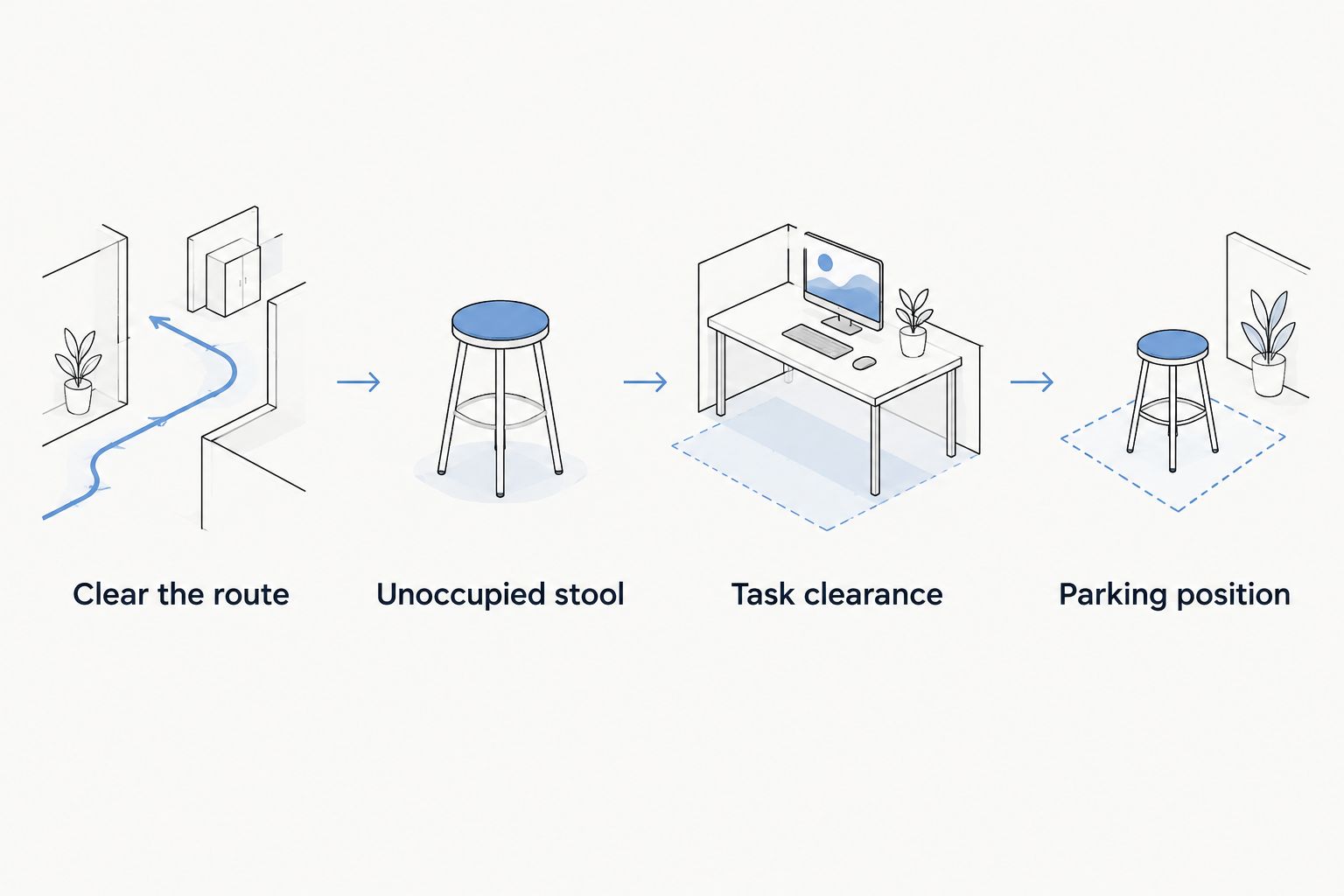
For a multi-room 2026 rollout, test 2 room types if your clinic has different layouts: a standard exam room and the most constrained relevant room. If layouts vary further, test those variations before extending the procedure.
Cleaning handoff and return to service
- Confirm who cleans the stool and when under your facility's procedure. Include any transfer between rooms in that decision.
- Match the cleaning and disinfection process to both the equipment manufacturer's instructions and the disinfectant label. Follow the required wet contact time; a quick wipe is not a substitute.
- Include the surfaces specified by the procedure, including adjustment controls and supports where applicable. Do not spray mechanisms, soak upholstery, or use chemicals contrary to the manufacturer's instructions.
- Define how staff identify cleaning status using the facility's established method. Keep equipment awaiting cleaning separate from equipment ready for use as the procedure requires.
- Return the stool to its assigned position after the process is complete. Escalate damaged surfaces or malfunctioning controls instead of returning the stool to routine use.
Expected result: The next clinician knows where the stool belongs and whether the required cleaning process is complete.
Keep 1 checklist per room as a proposed starting format for your 2026 operating procedure. It should identify parking, cleaning responsibility, status communication, and the maintenance escalation route—not duplicate the full equipment manual.
Variant: reset the stool whenever the clinician changes
A room-dedicated stool still needs a user handoff. Keeping the stool in place does not mean keeping the previous clinician's settings.
Use this adjacent workflow when clinicians rotate through the same room:
- Confirm that the required cleaning handoff is complete before use.
- Check height and any fitted supports before starting the task.
- Recheck instrument reach and pedal access after adjusting the stool.
- Return the stool to parking and communicate faults through the assigned process.
Best for: shared rooms with changing users. This reset preserves the benefit of room-dedicated seating while making individual fit explicit. Its trade-off is the need for each user to understand the controls rather than relying on a common setting.
Keep personal settings separate from cleaning status. A stool adjusted for the next clinician is not automatically ready for clinical use.
Troubleshooting
The stool rolls away during positioning
Stop using the stool for that task until its rolling behavior is assessed. Check the floor, caster condition, and any brake instructions; do not assume that a caster described as a safety brake locks in every situation.
Do not substitute wheels or glides without confirming compatibility and suitability. A stationary configuration also changes how the user approaches and leaves the work position.
The stool clears the doorway but catches beside the table
Repeat the clearance check with the door, drawers, and movable equipment in their normal working positions. Look for contact at the base, footring, backrest, and arm supports.
Change the parking position or equipment arrangement through the facility's layout process. Do not remove a functional component simply to force a fit.
The next clinician cannot reproduce a workable position
Check whether the problem is unfamiliar controls or an unsuitable adjustment range. Demonstrate the documented adjustment sequence, then reassess fit with that clinician's normal task and footwear.
If the stool cannot provide the required position, reassess the seating specification. Repeatedly reaching an adjustment limit is not a training solution.
Staff cannot tell whether the stool has been cleaned
Treat the stool according to the facility's procedure for uncertain cleaning status. Assign responsibility and use the established status system before restarting the shared transfer workflow.
Do not use parking position alone as proof of cleaning unless the facility's documented process explicitly defines it that way.
Customize your workflow
Expand the procedure by task rather than applying one seating setup to every department. Phlebotomy, dental chairside work, ultrasound, and charting each need their own reach and clearance assessment.
For your 2026 review, record the room, stool identifier, task, fit issues, cleaning documents, and unresolved faults. Compare recurring problems before deciding whether the answer is another stool, a different configuration, or a layout change.
Use Sithealthier's medical stool cleaning-document guide to organize the documentation questions. Do not buy an accessory to solve a workflow problem until compatibility and the underlying cause are confirmed.
FAQ
What's the best rolling medical stool exam room workflow for several rooms?
Use assigned parking, individual fitting, a checked movement path, and a documented cleaning handoff. Room-dedicated seating removes routine transfers; shared seating needs an explicit transfer procedure.
Should a medical stool stay in one exam room?
Keep a medical stool room-dedicated when eliminating cross-room transfers is the goal. Follow facility infection-prevention procedures when deciding whether equipment can move between rooms.
Can I roll between exam rooms while sitting on the stool?
Stand up before relocating between rooms and move the unoccupied stool according to its instructions. A rolling clinical stool is not a substitute for transport equipment.
How high should an exam-room stool be?
Set the stool height for the individual user's task, foot support, and work-surface relationship. Verify the exact model's adjustment range rather than applying a universal seat-height target.
Are saddle stools better than surgeon chairs for exam rooms?
Neither category is automatically better for every exam-room task. Compare seat fit, required supports, adjustment access, cleaning compatibility, and working clearance for the actual user.
Can any disinfectant be used on a medical stool?
Use a cleaning and disinfection process compatible with the stool manufacturer's instructions and the disinfectant label. Follow the facility's infection-prevention procedure and the required wet contact time.
What should I check before replacing medical stool casters?
Confirm caster attachment compatibility, floor suitability, brake behavior, and the equipment manufacturer's requirements. Wheel diameter or appearance alone does not establish compatibility.
One last thing
Test the empty room after turnover, not only the occupied work position. Ask a colleague to find the stool, identify its cleaning status, adjust it, and return it to parking using the procedure alone. Any point requiring an undocumented explanation belongs in the handoff instructions.

Leave a comment